Issuma, a Damien II Schooner
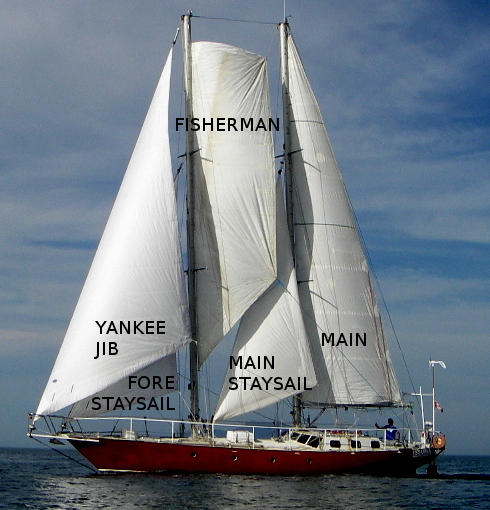
Issuma is a 15.34m (50') steel staysail schooner, built to Michel Joubert's Damien II design. The boat was built by the well-known metal boatbuilding yard of META (which also built Bernard Moitessier's Joshua design), in Tarare, France. As with many (or most) of these boats, they were sold for completion by the owner.
I understand the first owner unfortunately passed away before completing the boat. The second owner, Yann Sergeant, took most of these pictures and drew the interior plan, completed the boat and also sailed it 48,000 miles (under the name Shekin V).
Original Damien II design drawing (Issuma and several other Damien IIs were lengthened 1.5m from this to improve steering):

Out of the water:
The hull shape is designed to be forced upwards by ice pressure, rather than being crushed. The hull shape can be seen in these pictures of drying out on a beach:
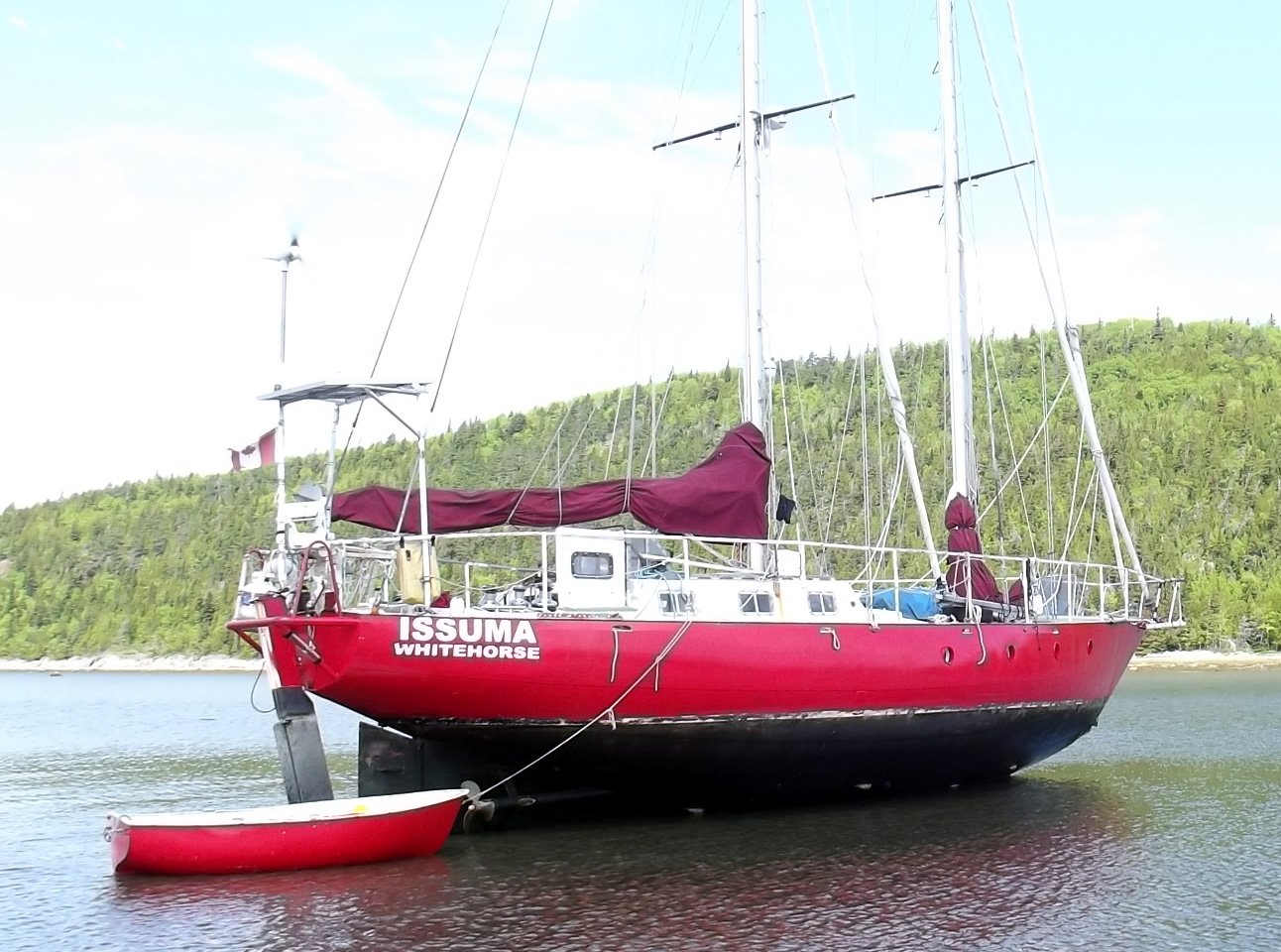
Drying out

Drying out

Drying out. The outboard rudder (black and white) is for the
windvane self-steering system. In this picture, the outboard rudder
is not attached and is just leaning at an angle against the hull
(it was detached before drying out)
Construction:
META built these boats supported by big wheels at the bow and stern, so the hull was slowly rotated during construction, making it convenient to work on. Steel hull plating is 4 mm – 6 mm thick (thinner above water line) welded clinker (overlap) style rolled steel with 8mm x 6 cm frames spaced 46 cm apart. The plates are fully welded, inside and out, with the overlaps such that water does not stay on the interior welds (to avoid corrosion).
Deck is 4mm steel plate.

Interior Framing
Centerboard and Ballast:
What is unusual about Damien IIs, and much of the reason they are such good expedition boats, is that all the ballast is in the centerboard or lifting keel. Details of Issuma's centerboard are here, Centerboard
Masts and Rig:
Both 15m/50' aluminum masts are stepped on deck. The aft mast is stepped on top of the pilothouse, which is about 30cm/1' higher than the deck where the forward mast is stepped. So Issuma has a schooner rig (staysail schooner rig to be precise).
Originally, Issuma had a 1.5m A-Frame-type bowsprit. I removed that because when breaking ice, the bobstay (wire supporting the bowsprit) was doing a lot of the icebreaking, and transmitting its load to the rest of the rig.
Interior layout:


Engine/Propulsion/Fuel:
72HP John Deere 4239 diesel engine (marinized by Baudoin) driving a hydraulic pump, connected to hydraulic motors on each of two folding propellers. With normal cruising speed of 4.5 to 5 knots, about 5 litres of fuel per hour are consumed--basically using about one litre per mile of motoring.
Day-tank under cockpit holds 70 litres of fuel. Keel fuel storage tank holds 700 litres fuel. Other internal fuel tanks hold a total of 200 litres fuel. In addition, 550 litres of fuel are carried in 11 "jerry jugs (50 litres each)", which are stored in purpose-built boxes belowdeck. This gives a theoretical range under power of about 1500 miles.
Heating System:
Dickinson Lofoten drip-pot diesel heater in the Pilothouse. Woodstove
up forward. Neither has been setup to run while sailing except in very light
wind conditions (normally chimneys are removed and pipes are capped before
sailing). Both have total stack heights of about 2.5m/7.5', which helps
with the draft. Lofoten has a "barometric damper" to add air to the stack
to reduce the amount of heat that would otherwise be lost up the stack.
Previous heaters used on this boat included a Sig Marine 120 drip-pot diesel heater which worked fine, but was not big enough for winter use; an old Wallas kerosene heater which I never had much luck getting operational; a Heater Craft heater that worked while the engine was running, and a forced-air diesel heater.

Lofoten heater in Pilothouse
Galley:
Galley has a two burner Force 10 propane stove with oven, fresh and salt-water foot pumps for the sink. Once upon a time there was a refrigerator, but it never worked well and was replaced with drawers. Living without refrigeration is not difficult once you learn how.
Freshwater tanks hold about 450 litres distributed in nine tanks.
Electrics/Electronics:
-
VHF with AIS receiver
-
Furuno 1623 radar
-
MerVeille radar detector
-
Furuno LS-6000 fishfinder/depthsounder
-
Furuno GP32 GPS (plus two spare handheld GPSes)
-
Raspberry Pi4 computer with OpenCPN navigation software (with a Raspberry Pi3 spare and also a laptop as backup, and also paper charts)
-
weatherfax receiver (see Weather Forecasts on Issuma)
-
Furuno NX-300 NAVTEX receiver
-
shortwave radio receiver
-
Iridium Go! satellite email device with external antenna
-
24-12volt DC-DC converter
-
120VAC inverters (small true sine wave inverter for chargers and computer, larger one for power tools)
-
transformer for 110-220VAC conversions
-
2000 watt gasoline generator
-
solar panels and controller
-
Primus AirBreeze wind generator
-
12 and 24 volt alternators on engine, each with Balmar Smart Regulators
-
Samlex 15Amp 24volt 110/220VAC battery charger
-
Schumacher 10Amp 24volt 110VAC battery charger
-
20 Amp DC Power Supply for equalizing batteries
-
two 3700 GPH, 1.5inch discharge, 24 volt bilge pumps
-
24 volt, 1 inch discharge, diaphragm bilge pump (also two manual, fixed bilge pumps)
-
Lofrans Falkon 24 volt anchor winch
-
24 volt winch for centerboard
Batteries are 12 volt, deep-cycle, Group 27 lead-acid. Two (or three in Arctic climates) batteries( wired in parallel for 12 volts) are used for the engine. Three banks of two 12 volt house batteries (in series) provide about 300 amp hours at 24 volts for the house bank.
Safety Equipment:
High liferails (95cm from deck) to keep people aboard.
Jacklines for safety harness tethers to connect to.
6 person liferaft, EPIRB, flares, hand-powered desalinator, handheld GPS & VHF
Lifesling and lifesaving ring
Boarding ladder
First aid kit
Other Damien II sites:
Northanger, a Damien II built in the UK has sailed all over and has chartered for many years in Patagonia and Antarctica. Greg & Keri's Northanger website (in English) is at http://www.northanger.org/en/northanger.php
Gerard Janichon's site (in French) about the various Damiens. Gerard and Jerome Poncet sailed the 10m plywood sloop Damien around the world and to Antarctica and the Arctic in the 1970s, subsequently prompting the design to their specifications, of high-latitude boats, Damien II and Damien III. http://www.gerardjanichon-damien.fr/les-autres-damien
La Libertaire, is a cutter-rigged Damien II being sailed far and wide by a family. Their blog (in French), is https://libertairegv.blogspot.com
There are several other Damien IIs that I am aware of, that do not have blogs or websites. If I've missed any that have blogs or websites, please let me know.
| Home | Issuma | Orbit II | Rosemary Ruth | Presentations | Contact |